

Are Subsidized Company Cars Blocking EV Growth in Germany?
Germany’s subsidized company car policy, where companies receive tax benefits to purchase vehicles, is significantly impacting the adoption of electric vehicles (EVs). Currently, a vast majority of company cars run on internal combustion engines, prolonging reliance on fossil fuels and slowing the shift to sustainable transportation. Given that company cars dominate business fleets, the country’s transportation sector faces challenges in reducing emissions.
The Prevalence of Company Cars
In Germany, two out of every three new cars registered in recent years were bought by businesses. Company cars used both for business and private purposes, often have higher fuel consumption and emissions due to increased mileage. Since companies cover fuel costs, employees typically drive these cars more frequently than private owners. Consequently, company cars contribute three-quarters of emissions from newly registered cars, making their environmental impact considerable.

Esmihel Muhammad | Pexels | In Germany, two out of every three new cars registered in recent years were bought by businesses.
Subsidies and Their Environmental Costs
The German government offers subsidies that favor premium vehicles, including fossil-fuel-powered company cars. These subsidies, amounting to €13.7 billion annually, are largely directed toward fossil-fuel cars, keeping them in circulation longer. The higher the purchase price, the greater the tax benefit, which incentivizes companies to purchase expensive vehicles, often heavy SUVs. This has led to a situation where one in three company cars in Germany is an SUV, a vehicle type known for its high emissions.
The Slow Adoption of EVs in Company Fleets
Despite Germany’s environmental goals, only 12% of new company car registrations in the first half of 2024 were fully electric. Some corporations are taking steps to promote EVs in their fleets, but progress remains limited. Deutsche Telekom, for instance, now requires all new company cars to be electric. However, such initiatives are rare, with companies like BASF and SAP maintaining a mix of hybrid and combustion-engine cars in their fleets.
While hybrid vehicles were intended to bridge the gap to full electrification, their environmental impact is debated. Many hybrids are rarely charged, running primarily on fossil fuel, which offsets their intended carbon savings. Without strong incentives to charge them, these vehicles end up having a heavier carbon footprint.
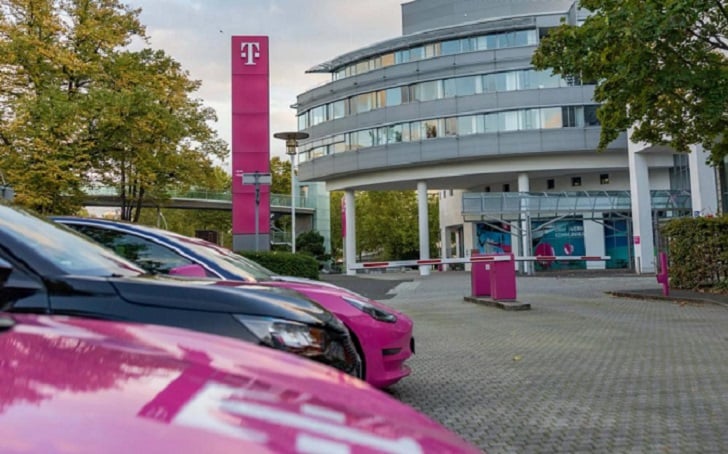
Credit: DW | Deutsche Telekom now requires all new company cars to be electric.
The Auto Industry’s Mixed Approach
Germany’s automotive industry stands to benefit from a shift toward EVs in company car fleets, as nearly 70% of their sales are to corporate clients. Therefore, major automakers like BMW and Volkswagen advocate for stronger electrification incentives. Yet, even among German carmakers, the commitment to fully transition company cars to electric remains limited. A recent report noted that only a third of BMW’s company cars are currently electric, highlighting the lag in adoption.
Subsidy Inequality and Potential Solutions
Subsidies for company cars largely benefit Germany’s top earners. According to the World Wildlife Fund, most company cars are used by employees with annual incomes above €80,000, raising questions about subsidy equity. Environmental advocates propose taxing vehicles based on CO2 emissions and promoting smaller EVs to address this. Additionally, providing benefits for sustainable alternatives, such as company bicycles and public transport passes, could ease both traffic congestion and parking shortages in German cities.
Challenges to the German Government’s Goals
Germany aims for net-zero carbon emissions in transportation by 2045. However, the continuation of subsidies for fossil-fuel-powered company cars conflicts with these goals. In 2023, EV subsidies for private individuals were scrapped, with Transport Minister Volker Wissing asserting that the EV market should stand independently. However, subsidies for corporate fossil-fuel cars remained untouched.
More inAuto News
-
`
 “Grand Theft Auto VI” Cover Art Revealed
Rockstar Games gave fans a fresh look at “Grand Theft Auto VI” after releasing the game’s official cover art on Thursday....
July 5, 2026 -
`
 Why ‘Super Commuting’ Is Becoming a New Normal in Northern California
For thousands of workers across Northern California, a long drive to work is no longer an occasional inconvenience. It has become...
July 3, 2026 -
`
 Why Advanced Headlights Used Worldwide Are Still Restricted in America
Night driving was once associated with quieter roads and a calmer driving experience. Today, many motorists face a different reality. Intense...
June 28, 2026 -
`
 How 2026 Graduates Can Establish a Solid Financial Ground for Future Decades
Graduation marks the beginning of a new financial chapter filled with opportunities, responsibilities, and choices that can shape the future. The...
June 26, 2026 -
`
 Is Running Your AC All Day Saving Money or Raising Energy Bill?
As temperatures climb, air conditioners become one of the hardest-working appliances in many homes. A common belief is that keeping an...
June 21, 2026 -
`
 Everything You Ought to Know About Car Insurance in Texas
Texas drivers cover millions of miles every day. They go through packed highways in Houston, long stretches of interstate roads in...
June 18, 2026 -
`
 Why Liability Auto Insurance Is Required but Full Coverage Isn’t
Car insurance rules often feel uneven. One part is enforced by law, while another is left to personal choice or financial...
June 14, 2026 -
`
 Mitsubishi Ends its U.S. Pickup Hiatus With Nissan-sourced Truck Aimed at Toyota Tacoma & Chevy Colorado
Mitsubishi is getting ready for a major comeback in the United States. After years of sitting on the sidelines in key...
June 12, 2026 -
AISD-77 fallback smoke aisd-77-smoke-72138678
Verifying the WordPress publisher’s auth-fallback cascade. This draft post can be deleted.
June 10, 2026
More From CashRoadster
-
 How Much Money Should You Keep in an Emergency Fund?
With everyday expenses remaining high across the U.S. in 2026, an emergency fund can provide a needed buffer when an unexpected...
AdviceSeptember 13, 2026 -
 How Staying With the Same Car Costs You More in Insurance
Loyalty usually sounds like something a company should reward. Stay with the same business for years, pay your bills on time,...
Car InsuranceSeptember 11, 2026 -
 State Farm Is Sending Out $5 Billion in Dividends. Here’s Who Qualifies
After several years of rising auto insurance costs, some State Farm customers are now getting money back. State Farm has started...
Car InsuranceSeptember 6, 2026 -
 Nissan’s Big Bet on Aggressive Discounts Is Fueling Sales As Competitors Pull Back
Nissan is spending more money to get buyers into its cars, and the strategy is producing results. While several major rivals...
Auto NewsSeptember 3, 2026 -
 Hyundai Gives Its Wild Baja Santa Fe Render the Green Light
The Hyundai Santa Fe is designed as a practical family SUV, but a new digital rendering gives it a very different...
Auto NewsAugust 30, 2026
You must be logged in to post a comment Login